My Husband Is Yelling at Me — Why, and What Can I Do?
Last updated: September 16, 2026 · By the YellingAtMe editor · How we write
If your husband just yelled at you, take a slow breath first. Being shouted at by the person who is supposed to be on your side lands in a particular spot: it can leave you feeling small, bewildered, or instantly apologetic for something you didn't do. Your hurt doesn't need a verdict on who was right before it counts. It counts. And one thing to keep hold of from the very first line: his yelling is his behavior to own — you did not cause it, and you can't cure it by being more careful.
What should you do if your husband is yelling at you right now?
In the moment: don't climb up to his volume. Put one sentence on the table that keeps the door open without accepting the shouting — "I want to hear you. I can't do it while you're yelling at me." — and step away if it continues. The goal is not to win the point; it's to stop the exchange from getting more expensive.
Next hour: let your body come down before you replay the tape. Sixty seconds of slow breathing does more for you right now than re-arguing in your head (there's a free tool for exactly that, further down). Then write what was actually said, in order, with no adjectives attached.
Coming weeks: one conversation about the yelling itself, in a calm hour, containing one specific request. That conversation is where "will he change?" stops being a hope and starts being something you can look at — the next section tells you what to look for.
Jump to: How to make it stop · While he is yelling · Why he yells · Is this abuse? · Afterward: the words
How to make him stop yelling — what is actually in your hands
You cannot make an adult stop yelling with better wording. What you can change is what the yelling achieves: no negotiation at volume, one calm boundary, a pause with a promised return, and a consequence you actually keep. His change is his work — your clarity is what makes it unavoidable, and what shows you whether it's coming.
Five moves, in the order they have to happen:
- Stop paying for the volume. If shouting reliably wins ground — you drop the topic, you apologize, you give in to end it — the shouting stays in the toolbox. Say so once: "I'll talk about this the second we're back at normal volume." Then wait.
- Take a pause you scheduled. "Twenty minutes, and I'm coming back for this." The return time matters as much as the break: a pause with a time on it reads as someone trying to fix things, not someone escaping them.
- Name the pattern once, in a calm hour. Not a summary of his character — one pattern plus one request. "Three times this month it ended with shouting. I want us to disagree without that, and I'll hold up my side."
- Keep one consequence you can actually carry out. "If it turns into shouting, I'm taking a walk and we finish this in the morning." Enforce it quietly and every single time. A boundary you remember half the time isn't a boundary; it's decoration, and he will learn the schedule.
- Watch the weeks, not the apology. Change looks like: he catches himself mid-escalation and stops; he mentions the pattern before you do; he doesn't resent the idea of a counselor. "He said he was sorry" is the entry fee, not the progress.
Two honest caveats. First, none of this is a technique for controlling another person — it changes what your half of the dance offers, which is the only half you get to move, and it may be answered with real change or with a clear refusal to engage. Both are information. Second, if pushing back has ever made him dangerous rather than quieter — a body in the doorway, things thrown, dread about what happens once you've told someone — that is not a communication exercise, and the safety notes at the end of this page are for you.
While he is still yelling: four moves
1. Keep your side of the conversation level
Going up feels like self-defense and is nearly always gasoline. Fight, flight, or freeze is running the room for both of you; your volume is the one dial still wired to you.
Couples therapists have a name for what happens under that sentence. "Flooding or Diffuse Physiological Arousal is the body's alarm system to help you escape a perceived threat," writes Kari Rusnak, a licensed professional counselor and certified Gottman therapist. Yelling is often the sound of someone past their own ceiling — which explains the moment and excuses nothing.
2. Put some distance in the room
Half the room, the doorway, the far end of the table. Space isn't avoidance — it cools two bodies that are both running hot, and it gives the next sentence somewhere to land.
3. Say the sentence once
One clear line, said once: "I'm not leaving you — I'm leaving the shouting. Twenty minutes." Repeating it, or improving it mid-argument, reads as a gauntlet rather than an offer.
4. Leave with a time attached
An exit with no return time feeds the loop described further down this page. Say when you'll be back; then be back when you said. That second half is the part that builds trust in pauses.
If it has crossed into threats, insults, intimidation, a body blocking the exit, or anything that makes you afraid of him, stop running de-escalation technique. Move toward safety and use support resources by country →.
Shaky right now? Try Calm Now — a free 60-second breathing space. Nothing is saved, nothing is tracked. Take a breath →Why is my husband yelling at me? 5 reasons that show up most
You're not going to diagnose him from a list, and his actual reason is his to bring, not yours to guess. The list is for orientation: most of what people describe here comes out of one of these five places — and which one you're dealing with changes what the next conversation should be about. Explanations, not permission slips.
Stress that walked in ahead of him
Work pressure, money, a dying parent, four hours of sleep. Volume frequently arrives at whoever it is safest to aim at. That's human, and it's still unfair to you.
A family where shouting was ordinary
If dinner in his childhood home meant everyone talking over everyone, a raised voice may sit inside him as "how conflict works" while it lands on you as an assault. Learned, so unlearnable — but only by him, and only if he's willing to see it first.
Dr. Kia-Rai Prewitt, a psychologist at the Cleveland Clinic, has seen how deep that wiring runs: "Whether they've experienced childhood trauma in their own families or from peers, some people are accustomed to being spoken to in an abusive way." Being raised around it explains where the volume came from. It does not make it land any softer.
Feelings he was never handed words for
A lot of men were taught one acceptable emotion to show out loud. Hurt, fear, shame and loneliness then come out sideways as anger, because anger was the only door left open. This one matters, because it's usually not about you at all.
The loop where silence buys volume
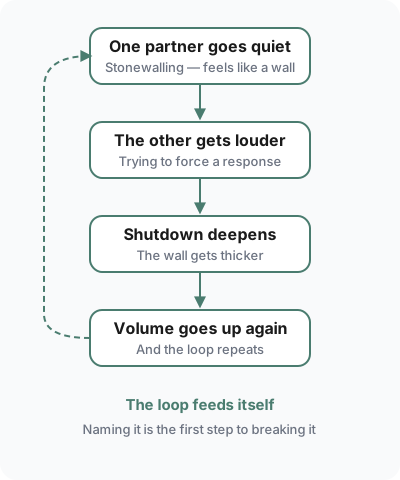
When one person goes quiet to keep the peace, the other often gets louder just to be heard — and each new decibel makes the shutdown tighter. It is the most common engine in these stories, and naming it requires no verdict about who started it: it's the one part both of you can act on.
What a doctor would ask about
Sleep debt, chronic pain, untreated depression, thyroid trouble, alcohol: irritability has physical suppliers. A professional sorts that out — it is not a job for either of you at the kitchen table.
None of the five makes yelling acceptable. They make it a problem with a shape, and shaped problems are the kind you can put a plan against.
Is it a bad night, or is this verbal abuse?
Plenty of couples have let volume fly in a bad hour and then repaired properly. The line people keep asking about isn't decibels — it's these four, and you can hold them in your head at 2am:
- Frequency — is shouting simply how disagreement works around here, an ordinary Tuesday rather than an event?
- Direction — is it about the thing that happened, or about what's wrong with you as a person?
- Degradation — do insults, mockery, name-calling or threats ride along with the volume?
- Fear — do you feel jumpy in your own home, and have you quietly trimmed parts of your life to keep the temperature down?
You may have come here searching for emotional abuse rather than verbal abuse — the two overlap heavily, the hotline's own definition covers both, and the four questions above apply either way.
If the last three made your chest tighten, the full self-check is on its own page. It's gentle, it doesn't label anyone, and it doesn't ask you to decide anything today: Is yelling normal in a relationship? →
When the yelling has ever turned into hitting
People search "my husband yells at me and hits me" looking for a why, and I want to be honest about how unhelpful that question is here. There is no version of the answer where the cause turns out to be something you did, so the explanation you're hunting for is not the thing that will make this stop or make you safe. Hitting is not volume with an extra step. It's a different category, and it doesn't need a bruise to belong to it — a hand on your arm to block a doorway, grabbing your phone, a grip you have to plan around.
So skip the diagnosis and do the practical thing: write down what has actually happened, in dates, because memory softens these things fast. Then read support resources by country →, which covers what to have ready and who to call — including if nothing has happened yet tonight and you just don't want to find out.
When it's the words, not the volume
"He swears at me when he's angry" is a different complaint than "he raises his voice," and it's usually the one that sticks. Some couples curse with each other and it means nothing; the discriminator isn't the vocabulary, it's the direction. "You're being ridiculous, and I said a bad word while saying it" is about the argument. "You're a f***ing idiot" is about you, and it will keep working whether or not he ever hits you, because it rearranges what you believe about yourself before the next conversation starts.
If you can't tell which one you're living in, say the sentence out loud to a friend. Not to him, not yet. Secondhand, the difference is usually obvious in about four words.
How to raise it afterward without a second fight
Timing beats technique: not in the wreckage of the argument, not the moment he walks in the door. Talk about the yelling, not about the topic he yelled about. Three openers that describe your experience without swinging at him:
"I felt hurt when you raised your voice last night. I want us to be able to disagree without yelling."
"I shut down when I'm yelled at, and then we solve nothing. Can we agree to pause next time it gets loud?"
"I love you, and I don't want to be spoken to like that. What was going on for you last night?"
Need the exact words for a situation these don't fit — including if he insists he never yelled? What to say after a fight — copy-ready scripts →
If it happened in front of other people
The public version has its own weight, and it isn't only embarrassment. You're now carrying a second thing he usually won't name: that someone saw it. Which is why the follow-up conversation goes sideways so often — you start on the yelling, and he answers on the audience, and by minute four you're defending yourself for "humiliating him in front of his friends."
Two things help. Name the public part as its own item, not as evidence: "last night, in front of my sister" is a separate sentence from "you shouted at me." And don't litigate it while witnesses are still in the room — the shame you're trying to hand back to him will only make him defend it, and you'll lose the actual point. If he keeps doing the thing he apologized for in private but never in public, that gap is information too.
Counseling, safety, and where technique ends
Bring in a counselor when the same argument keeps rerunning with different props, when shouting has become the normal register of disagreement, or when he says he wants it to change and nothing changes. That last one is usually the moment a third person earns their fee: two people inside a pattern can't always referee it. A counselor isn't a judge — closer to an interpreter for two people talking past each other.
And where this page stops: at fear. Communication advice is for two people who still both feel safe. If his yelling comes with threats of any kind (including the "joking" ones), objects thrown, walls punched, hands on you, or the plain fact that you feel uneasy in your own home, this is past scripts — and it is real regardless of gender. Find support resources by country →. You are allowed to reach out before anything worse happens; waiting for a reason you'd regret is not the bar.
Key takeaways
- No one can make a husband stop yelling by choosing better words; what shifts the pattern is changing what yelling achieves — no negotiating at volume, one calm boundary, a scheduled pause, one consequence you keep.
- Your husband's yelling often has a source — stress carried home, a household where shouting was ordinary, feelings he was never given words for — and a source is an explanation, never a permission slip.
- Judge change by weeks of different behavior under stress, not by the apology in the kitchen ten minutes later; repair that alters nothing is repetition with better manners.
- If your husband's yelling is frequent, aimed at you rather than the problem, or leaves you afraid in your own home, take the self-check in our "Is yelling normal?" guide — fear is information, not overreaction.
Frequently asked questions
What should I do if my husband is yelling at me right now?
Keep your voice at conversation level, create some physical space, and say one clear sentence such as, "I want to hear you, but not like this. Let's pause." If the yelling continues, leave the room if you can do so safely — and come back to the conversation only when you're both calm. If there are threats, violence, blocked exits, or fear, use safety support resources instead of trying to de-escalate alone.
Why does my husband yell at me over small things?
The "small thing" is usually the trigger, not the cause. Accumulated stress, unresolved resentment, or feeling chronically unheard can build up until a minor moment sets it off. That doesn't make the yelling okay — it means the real conversation is about what's underneath, not about the dishes.
Is my husband yelling at me verbal abuse?
It crosses into verbal abuse when it is frequent, aimed at you rather than the problem, includes insults or threats, or leaves you afraid. Occasional raised voices during conflict, followed by genuine repair, happen in many relationships and aren't automatically abuse. If any of those ring true, take the full self-check in our guide on whether yelling is normal — and trust what you find.
Should I yell back at my husband?
It's understandable — and it almost never helps. Yelling back escalates the loop and puts adrenaline in charge. Staying at conversation volume isn't surrender; it's the one move that can interrupt the pattern. And if you can't stay calm in the moment, leaving the room beats matching his volume.
Is it my fault that my husband yells at me?
No. People ask this constantly, and the honest answer is that you can say something clumsy, pick a bad moment, or fail to hear something he needed — and none of that hands another adult their volume. Blame feels like control ("if I caused it, I can fix it"), which is why it's so tempting and so unhelpful. What's yours to own is your part of the argument. His yelling is his.
My husband yelled at me and I can't stop crying — is that normal?
Yes, it's a normal stress response. Crying after being yelled at is your nervous system releasing pressure, not a sign of weakness or that you "lost." Your body just absorbed a surge of adrenaline and cortisol, and tears are one of the fastest ways it brings that back down — it doesn't mean you're unstable, and it doesn't mean the yelling was justified. What helps right now: 60 seconds of slow breathing to settle your body, then a glass of water and a quiet few minutes before you decide anything. If the crying lasts for hours, comes with a sense of dread, or this keeps happening every time, that's worth talking to someone about — and the self-check in our guide on whether yelling is normal can help you look at the pattern.
Will my husband ever stop yelling?
People can change how they communicate — but only when they own the problem and practice under real stress, sometimes with a counselor's help. What you control is your boundary: what you'll engage with, and what you'll walk away from. Lasting change starts with him wanting it, not just you wanting it for him. The section on this page called "How to make him stop yelling" walks through what that looks like in practice.
Why does my husband yell at me but say he loves me?
Love and hurtful behavior can coexist — and that contradiction is exactly what makes it so disorienting. Someone can genuinely love you and still struggle to manage stress, anger, or learned habits in healthy ways. But love doesn't cancel out the impact of yelling, and saying "I love you" doesn't repair the harm by itself. What matters is the pattern: if the apology-and-yell cycle keeps repeating, the words start losing their repair value. If that sounds familiar, the self-check in our guide on whether yelling is normal can help you think it through.
Related guides
Sources
- The National Domestic Violence Hotline — What Is Emotional Abuse — definitions and warning signs of emotional and verbal abuse
- The Gottman Institute — Does Flooding Play a Role in Your Perpetual Conflict? — what flooding is, and why a flooded person can't hear reason
- Cleveland Clinic — Verbal Abuse: What It Is and How To Address It — a psychologist's breakdown of verbal abuse and how to respond
- Harvard Health — Fight, Flight, or Freeze — how the body's stress response works when someone yells
Curious why this phrase is trending online? Read the story →