Is Yelling Normal in a Relationship? 4 Signs to Look For
Last updated: August 27, 2026 · By the YellingAtMe editor · How we write
The fact that you're asking this question says something good about you: you're taking your relationship — and yourself — seriously. This page won't hand you a verdict, because no page honestly can. What it will give you is a clear frame: what tends to be within the range of ordinary conflict, what tends not to be, and a gentle way to look at your own situation.
Is yelling normal in a relationship? The short answer
Sometimes — but not as a rule. Occasional raised voices can happen in a relationship, especially when both people later acknowledge what happened, apologize without excuses, and make a real effort not to repeat it. One heated moment does not define an entire relationship.
It is more concerning when it becomes a pattern. Yelling that is frequent, aimed at you rather than the problem, paired with insults or threats, or leaving you afraid and walking on eggshells is not simply "how couples argue." It deserves to be taken seriously. The guidance written for couples by relationship researchers is blunter than this page is willing to be: "While conflicts can occur, consistent yelling is not a healthy form of communication," writes Kendra Han, MSW, who directs couples programs at The Gottman Institute.
The clearest answer: there is no magic number that decides whether yelling is normal. Look at four things instead: how often it happens, who it is aimed at, whether it degrades you, and whether it makes you afraid. This page walks through each one without giving you a label or diagnosis.
Jump to: Moment vs. pattern · Where the line is · When it becomes emotional abuse · Self-check
A bad moment vs. a pattern
The same behavior — a raised voice — can mean very different things depending on what surrounds it. Here's the honest comparison:
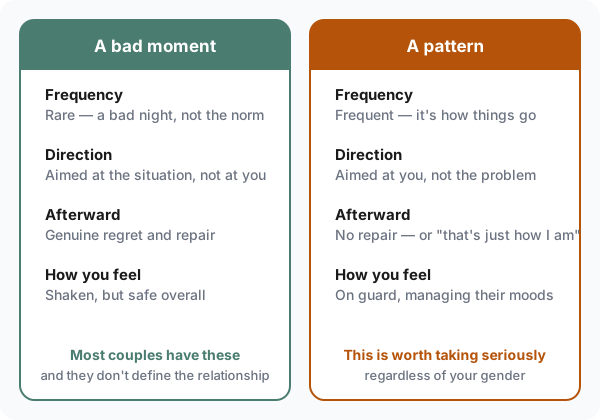
A bad moment
- How often
- Rare — you can count the times.
- What happens after
- A real apology, and visible effort to not repeat it.
- What it's aimed at
- The situation ("This is so frustrating!").
- How you feel
- Upset in the moment, but fundamentally safe.
A pattern
- How often
- Regular — it's how disagreements usually go.
- What happens after
- Apologies that change nothing — or no acknowledgment at all.
- What it's aimed at
- You ("What is wrong with you?").
- How you feel
- Tense before it happens, afraid while it happens, smaller after.
Neither column is a diagnosis or a verdict about your relationship. They are a way to notice patterns: occasional conflict can be repaired, while repeated yelling that creates fear, humiliation, or control needs a different kind of support.
From raised voices to something more
Conflict behaviors sit on a spectrum. Naming the bands helps you see movement — because patterns rarely start at the far end.
Raised voices. Volume climbs in a heated moment, on both sides, about the issue. Uncomfortable, common, and workable — especially if you can talk about it calmly later.
Repeated yelling. One person regularly uses volume to dominate disagreements. The topic no longer matters much; the pattern is the message: my anger sets the rules here.
Degrading or threatening. Yelling that carries insults, name-calling, mockery, or threats — of any kind — has crossed out of "communication problem" territory. This is where the word verbal abuse becomes accurate, not dramatic.
The line clinicians draw is narrower than it feels from inside a fight. "There are ways to give feedback about people's actions or behavior without being hostile or rude," says Dr. Kia-Rai Prewitt, a psychologist at the Cleveland Clinic. Hostility aimed at who someone is, rather than what they did, is what moves a moment across that line.
Movement along this spectrum tends to be gradual, which is exactly why it's hard to see from inside. That's what the next two sections are for.
When does yelling become emotional abuse?
There is no volume that decides it, and no tally of incidents that does. Yelling slides from conflict toward emotional abuse when it stops being about the disagreement and starts being about you: frequent, one-directional, carrying insults, mockery, blame-shifting or threats, and followed by nothing that changes. That's a pattern to notice — not a label, and not a verdict.
The National Domestic Violence Hotline's definition doesn't hedge about volume: "Emotional abuse includes non-physical behaviors that are meant to control, isolate, or frighten you." And it names this page's exact subject without requiring a bruise: "Sometimes emotional abuse is more obvious, like a partner yelling at you or calling you names."
The words first. You'll see this territory described as verbal, emotional, and psychological abuse, often interchangeably. Roughly: verbal points at what is said, while emotional and psychological point at what the whole climate does to you over time — and that second group can operate entirely without words. If you arrived searching one term and found another, you're in the right place.
Four things that separate a bad argument from something that deserves a closer look — none of them about how loud it got:
- Who the argument ends up being about. In a bad argument, the topic stays the topic. As it slides, the topic quietly becomes you: your character, your memory, whether you're "just being dramatic".
- Who gets to end it. In an argument either person can call a break and the fight stops. Where it has become something more, only one person's exit works, and the other learns to wait it out.
- What an apology is for. Repair changes the next time. An apology that only resets the clock — sorry, calm, buildup, blow-up — is a part of the pattern, not the way out of it.
- What you've quietly given up. Subjects you don't raise, friends you stopped visiting, the mood you pre-empt on the drive home. Losing ground in your own life is the clearest sign, and usually the least dramatic one.
None of that is a diagnosis — of her, of you, or of the relationship. If more than one of those four reads like an ordinary week for you, the useful next step isn't a term to use about your relationship — it's a set of eyes that isn't inside it: a therapist, a doctor, one person you trust. The self-check below is the quiet version of that first step, and you can do it in about two minutes: check the four signs →
Is the yelling a pattern? Check these 4 signs
Four dimensions can tell you more than a simple count of how many times someone has raised their voice: frequency, direction, degradation, and fear. There is no score and no diagnosis at the end — just an honest look at whether this feels like an isolated conflict or a pattern that is affecting your sense of safety.
Frequency
Frequency asks whether yelling is a rare exception or the usual way disagreements happen. A pattern that is becoming more frequent deserves attention even if each individual argument seems explainable.
- Is yelling a rare exception, or part of most disagreements?
- Can you remember the last three arguments that didn't involve yelling?
- Is it becoming more frequent over time?
Direction
Direction asks whether the anger is aimed at the situation or used against you as a person. Criticizing a problem is different from using volume to attack, control, or silence you.
- Is the yelling about the problem — or about you as a person?
- Do phrases like "you always," "you never," or worse show up?
- Does it continue even after you've backed down?
Degradation
Degradation includes insults, name-calling, mockery, humiliation, and threats. An apology matters most when it is followed by changed behavior, not just another cycle.
- Does yelling come with insults, name-calling, or mockery?
- Have things been said that you'd be ashamed to repeat to a friend?
- Are apologies followed by real change — or by the next round?
Fear
Fear asks what the conflict is doing to your sense of safety. Editing your words, monitoring a partner's mood, or feeling afraid of what may happen is important information, even if nobody has hit you.
- Do you feel tense when you hear them come home?
- Do you edit what you say or do to avoid setting them off?
- In the middle of the yelling, do you ever feel afraid — of them, not just of the fight?
If most of your answers sat comfortably in the "rare exception" territory, what you're dealing with is likely a communication problem — hard, but workable. If the questions in the last two dimensions made your chest tighten, please keep reading. The next section is for you.
That was a lot to sit with. If you need a minute, take it — free and private. Nothing is saved, nothing is tracked. Take a breath →If the checklist worried you
First: nothing is wrong with you for being here, reading this, feeling what you're feeling. Recognizing a pattern from inside it is genuinely hard, and you just did some of that work.
You don't have to decide anything big today. Reasonable next steps come in sizes: talk to one person you trust; write down incidents with dates, just for yourself; talk to a counselor on your own (your partner doesn't need to agree, or know, for you to go once).
And if any part of you is afraid of your partner — afraid of what happens if they found out you read this page — please treat that feeling as information, and look at the support options available where you live: find support resources by country →
Key takeaways
- Occasional raised voices followed by genuine repair are common in relationships and fall within the range of ordinary human conflict — a rare heated moment is not, by itself, a warning sign.
- Yelling becomes a pattern worth taking seriously when it is frequent, aimed at you rather than the problem, carries insults or threats, or leaves you afraid and walking on eggshells.
- The line between a bad moment and a pattern is less about volume than about direction, frequency, and fear — the self-check on this page walks through all four dimensions quietly.
- Yelling can stop when the person yelling owns it as their problem and practices something different — but you don't have to wait, and individual counseling is available to you without your partner's permission.
- The labels people search — verbal, emotional, psychological abuse — overlap more than they differ. What separates a bad argument from a harmful pattern is not decibels: it's whether it runs one way, whether repair changes anything, and how much of your life you've handed over to keep the peace.
Frequently asked questions
Is yelling normal in a relationship?
Occasional raised voices followed by a genuine apology and visible effort to change can happen in otherwise healthy relationships. Yelling is more concerning when it is frequent, directed at you, degrading, threatening, or leaves you afraid. There is no fixed number that decides the question; the pattern and its effect on your sense of safety matter more.
Is yelling abuse?
Yelling is not automatically abuse. It becomes verbal abuse when it is frequent, aimed at you rather than the problem, carries insults or threats, or leaves you afraid. Occasional raised voices with genuine repair are common in relationships and don't, by themselves, cross that line. The self-check above walks through exactly these dimensions.
What's the difference between verbal abuse and emotional abuse?
Verbal abuse is about what gets said — insults, name-calling, threats, volume used to dominate a conversation. Emotional (sometimes called psychological) abuse is the wider category: it can include contempt, humiliation, the silent treatment, controlling what you spend or who you see, and making you doubt your own memory. Yelling can show up in either, and plenty of yelling never belongs in either. The useful question isn't which term fits — it's whether what's happening is frequent, one-directional, degrading, and quietly shrinking how you live.
Do all couples yell?
No — plenty of couples argue for decades without yelling. But many otherwise healthy couples do raise their voices sometimes. The presence of an occasional raised voice says less about a relationship than what follows it: repair, or repetition.
Can yelling stop?
Yes — when the person yelling owns it as their problem and practices something different, sometimes with a counselor's help. What doesn't work: you managing their moods for them. If they're willing, a calm conversation is the starting point — here's what to say →. If they're not willing, that unwillingness is itself an answer.
When should we seek counseling?
Consider counseling when the same fight keeps repeating, when yelling has become the default language of conflict, or when you've both tried and can't get traction alone — and most couples wait longer than they should. And individual counseling is always available to you — you don't need your partner's participation, or permission, to talk to someone.
What's the difference between yelling and screaming?
Yelling is usually words at high volume — an attempt to overpower or to be heard. Screaming is more raw sound than words, often closer to a loss of control. The distinction matters less than you'd think: if either is frequent, aimed at you, degrading, or frightening, the label doesn't change what you should do about it. The self-check above applies to both.
How much yelling is normal in a relationship?
There's no fixed number, but a useful benchmark: if you can count the times in a year, and each one was followed by genuine repair, that's within the range of ordinary conflict. If yelling is how most disagreements go, or if you've stopped counting because it's too frequent, you're past the "normal" threshold — and the four dimensions above (frequency, direction, degradation, fear) are a more honest guide than any tally.
Related guides
Sources
- The National Domestic Violence Hotline — What Is Emotional Abuse — definitions and warning signs of emotional and verbal abuse
- Cleveland Clinic — Verbal Abuse: What It Is and How To Address It — how clinicians separate harsh feedback from verbal abuse
- The Gottman Institute — Why Is My Husband Yelling at Me? — a couples-program director's view on yelling, boundaries and repair
Curious why this phrase is trending online? Read the story →