My Wife Is Yelling or Screaming at Me — What Should I Do?
Last updated: August 27, 2026 · By the YellingAtMe editor · How we write
If your wife just yelled at you, put down the phone and read this first. Being screamed at by the person you share your life with stings in a way that's hard to put in words — partly because of what just happened, partly because nobody ever told you that you were allowed to be hurt by it. You are. Two things are true at the same time here: whatever she is carrying matters, and what just landed on you matters. This page is mostly about the second one, because it's the one you can act on tonight.
My wife is yelling or screaming — what do I do in the next five minutes?
Right now: don't shout over her, and don't go stone silent and stare at the floor either — both answers make it worse. Put one sentence down and mean it: "I want to solve this with you. I can't do it at this volume. Ten minutes, then I'm back." An announced pause de-escalates; a silent withdrawal pours fuel on it.
Once she's stopped: your body is still in the argument even though the argument isn't. Take a minute of slow breathing before you rehash anything (we built a free 60-second tool for exactly this — it's below). Then note what was said, in order: facts first, your reading of it second.
Over the next weeks: talk about the yelling, not about whatever the yelling was about. And if the volume is regular, aimed at you rather than the problem, or has you braced for it when she comes home — that's past communication tips, and there's a self-check further down for exactly that.
If anyone in this is frightened — of her, or of what happens after you told someone — skip to the last section. That's a safety question, not a conversation question.
Jump to: Five moves now · What sits underneath · Why men don't tell anyone · The kids hearing it · Where the line is
Five moves while it is still loud
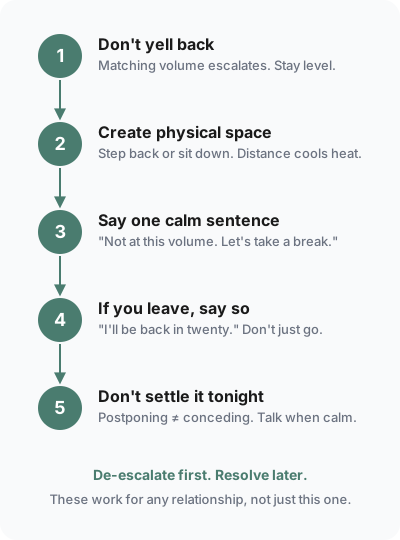
1. Don't yell back
Two raised voices in one room don't cancel out; they compound. Holding your side at conversation level isn't losing — it's the only move available to you that can slow the thing down, and it's the one your kids will remember.
2. Create physical space
Step back, sit down, move to the other side of the table. Distance lowers the physical temperature on both sides — and for a man, deliberately unhurried movement matters: slow hands, open palms, no crowding. You being calm is data for her, and for anyone watching.
3. Say one calm sentence
One, out loud, not four times: "I want to sort this out, but not at this volume. Twenty minutes, then let's try again." Said once and calmly, it's an offer. Repeated, it becomes provocation — an argument inside the argument.
4. If you leave, say so — don't just go
Walking out mid-sentence is the classic accelerant: she gets louder to force a response, you go quieter to survive the noise, and the loop tightens. Use an exit script instead: "I'm not shutting you out — I need to cool down so I can actually hear you. Back in twenty."
5. Don't settle it tonight
Nothing requires the topic to be resolved while both of you are still shaking. Deferring the argument is not admitting it — it's taking it seriously enough to have it properly.
If the screaming comes with threats, things thrown, a hand in the doorway, or anything that makes you afraid, stop treating this as a communication drill. Get yourself to safety and use the support resources listed here →.
Shaky right now? Try Calm Now — a free 60-second breathing space. Nothing is saved, nothing is tracked. Take a breath →Why is my wife yelling or screaming at me? 5 things usually underneath
Her real reason is hers to bring to the table, not yours to dig out of a list. What the list is for is orientation: these five cover most of what men describe to us — and the shape of the answer changes what you two need to talk about later.
The load nobody puts down
The scheduling, the remembering, the arranging, the emotional housekeeping — women in heterosexual marriages report carrying a disproportionate share of it, and it is invisible precisely because it works. Invisible work that never gets set down doesn't come out as a request; it comes out as a fuse, usually attached to something trivial like dishes.
She stopped feeling heard a while ago
Small frustrations that never get spoken don't evaporate — they stack. When stacked resentment finally gets a voice, its volume matches the months of buildup, not the ten seconds that triggered it, which is why it so often looks disproportionate to the person on the receiving end.
Flooding: her volume chasing your quiet
This one is genuinely two-sided, and it's worth understanding in your own body. Men tend to go into physiological overload in conflict faster and come out of it slower — Gottman researchers call it flooding, and stonewalling is what it looks like from the outside: you go quiet to stop the spiral. She experiences the quiet as a wall, raises her voice to get a person back, and the louder it gets, the deeper your shutdown goes. Naming the loop is not taking blame for it — it's the one piece both of you can grab.
Scott R. Woolley, a professor of psychology at Alliant International University, puts that reframe plainly in an interview with The Gottman Institute: "It's really helpful to start thinking about the pattern itself because it's the negative pattern that is the enemy – not the other person."
The volume she grew up with
If shouting was normal in the house she grew up in, a raised voice may register to her as "we're arguing" while it lands on you as an attack. She may genuinely not know she's doing it. That pattern can be learned off — once it's seen, and once she agrees it should be.
Sleep, hormones, and what a doctor would check
Postpartum months, perimenopause, thyroid, chronic pain, depression nobody has treated: all of these flatten a fuse. Worth ruling in or out with a professional — not with either of you playing clinician across the dinner table.
None of the five makes it okay. They make it a problem with a shape, and a shaped problem is one you can say something useful about.
The part that's harder to admit: being yelled at as a man
There's often a second injury sitting next to the yelling, and it's the one men describe quietly: not who yelled, but the fact that nobody was told. Some version of "shake it off, she's just expressing herself, you're supposed to be thicker-skinned than that" got handed to you at some point, so now you're doing math on whether you're allowed to be hurt — and the answer is yes, you don't have to qualify for it.
There's also a credibility problem that isn't discussed much: when the same fight is described by a large man and a smaller woman, people's eyes often go to him first. He's bigger, so he must be the danger. That assumption makes a lot of men edit the truth before they say it out loud, and it's one reason men count this kind of thing in years rather than incidents. If you have never told a soul, that's worth taking seriously as a symptom of the situation, not proof that the situation is fine.
This is shame in the technical sense, which the researcher Brené Brown defines as "the intensely painful feeling or experience of believing that we are flawed and therefore unworthy of love and belonging." Shame is good at one thing: pointing the problem back at you, so nobody has to look at what was done.
Two things to hold at once, because both are true: being hurt by her yelling does not make you the aggressor by size, and her being smaller does not make the behavior harmless. One of you can be terrified without ever being hit. That combination is why the check later on this page asks about fear and frequency rather than about who is stronger.
Practical version: tell exactly one person who won't try to manage this for you. Not a mutual friend with an opinion about your marriage — a brother, an old mate, a therapist. This stays unbearable mainly when it stays private.
When the kids are in the room
If your wife yells at you where your children can hear, the stakes change — it stops being about the two of you. Kids don't need to be the target to be affected; watching a parent get screamed at is scary and confusing, and repeated often enough it teaches them that volume is how adults handle a problem. Some of them quietly decide it's their job to fix it.
In the moment, your job is one thing: be the calm adult in the room. You don't have to defend yourself or land a point in front of them — a child watching their father stay steady under fire is learning something no argument could teach. If you can, move the conversation somewhere they can't hear: "Let's talk about this where we can hear each other."
Afterward there are two conversations, and the one with the kids is short. "Mom was really frustrated, and she shouldn't have yelled. This wasn't your fault. We're okay, and we're working on it." That's not throwing her under a bus — it's naming the behavior without naming her as bad, which is precisely the distinction children need. With your wife, the topic that evening is not the original argument; it's the audience. That's a boundary worth stating once, clearly, and holding.
If the yelling in front of them is regular rather than rare, your kids are adapting to it, and adapting isn't the same as being fine: Is yelling normal in a relationship? →
Is it abuse, or a bad patch? Four things to look at
Most couples have lost their volume somewhere and repaired it after. What separates a rough stretch from emotional abuse isn't how loud she got on Tuesday — it's these four.
- Does it run one way? A bad night is mutual or rare. What deserves attention is yelling as the standard format of disagreement, with you doing the adjusting.
- What is it aimed at? "This is impossible!" is a feeling about a situation. "What is wrong with you?" is a verdict about you.
- What rides along with it? Name-calling, mocking, contempt, threats — those change the category, not just the volume.
- What have you started doing? If you monitor her mood on the drive home, choose your words carefully, or drop subjects to keep the house level, that's the answer to a question you didn't ask yet.
Being on the receiving end as a man changes nothing about the standard — and checking is not an overreaction. The full self-check is written to be gentle and to avoid labeling anybody: Is yelling normal in a relationship? →
Words for the next conversation
Wait until you're both actually out of it — often not the same evening, and that's fine. Keep the topic narrow: the yelling itself, not the thing she yelled about. Three openers that say what happened without accusing her of being who she isn't:
"I felt small yesterday when your voice went up. I want us to disagree without that."
"When I get shouted at I go quiet — not because I don't care, because I freeze. Can we agree to call a pause next time?"
"I love you, and volume can't be how we fix things. What was actually going on for you yesterday?"
Looking for wording for a harder version of this — an apology that never came, a repair you don't believe? What to say after a fight — copy-ready scripts →
Where this page stops, and who to bring in
Counseling earns its keep when the same fight keeps replaying with new props, when shouting has become the default way disagreement sounds in your house, or when you've both tried and nothing moves. A counselor isn't picking a winner — think interpreter for two people who keep missing each other. Going alone is also allowed, and it's a common first move for men in exactly your position.
And here is the line this page will not follow you past: advice about talking stops where fear starts. Threats — even the ones delivered as a joke. Objects thrown or broken. Something between you and the door. Staying vague about it to a friend because you don't want to exaggerate. If any of that is in your house, the next step isn't better wording, and the support listed here is open to men as well: find resources by country →
Key takeaways
- When your wife is yelling, the two moves that work are staying at conversation volume and staying visibly engaged — matching her shouting or shutting down both feed the loop.
- Your wife's yelling usually points at what came before the argument (unspoken resentment, the mental load, a childhood where volume was normal) — which explains it, and never excuses speaking to you like that.
- Many men under-report this because they assume they won't be believed; the fear of being read as the bigger, therefore the guilty, person is real, and it is not a reason to absorb what's happening to you.
- If her yelling is one-directional, aimed at you rather than the problem, or has you managing her moods to keep the house calm, the standard for emotional abuse is the same whatever your gender — take the self-check in our "Is yelling normal?" guide.
Frequently asked questions
What should I do if my wife is yelling at me right now?
Two moves beat every instinct you have: stay at conversation volume, and stay engaged enough that she doesn't read you as checking out. Say one sentence — "I'm not walking away from you, I'm stepping away from this volume for ten minutes" — then take the ten minutes and come back. If she blocks you from leaving, threatens you, or you are afraid of what follows, this stops being a de-escalation exercise: use safety support resources.
Why does my wife yell at me?
Usually it's less about the moment and more about what's underneath: spilled-over stress, feeling chronically unheard, resentment that never got said out loud, or conflict habits learned long before you met. Knowing which one you're dealing with matters, because each points to a different next step — but none of them makes yelling an acceptable way to speak to you.
Is her yelling emotional abuse?
The question that actually sorts it isn't "how loud was she" but "what is the yelling doing." Watch for a pattern that runs one way, targets you instead of the issue, drags in contempt or threats, and leaves you tracking her mood to keep the house level. Occasional volume followed by real repair sits in ordinary conflict. The same standard applies to every gender, and our self-check guide walks through it without handing out labels.
Should I just stay silent when she yells?
Silence in the moment can feel like the safe move, but an open-ended shutdown often reads as a wall — and walls tend to raise the volume. The middle path: one calm sentence, an announced pause, and a promised return. You're not obligated to absorb yelling, and you don't need to win the exchange either.
How do I bring it up without starting another fight?
Pick a calm, neutral moment — not right after an argument, not mid-stress. Lead with your experience, not her behavior, using "I" statements like the openers above. Keep the first conversation small: one pattern, one request. If every attempt still collapses into a fight, that itself is a sign a counselor could help.
My wife screams at me — is that different from yelling?
Screaming tends to carry more raw emotion and fewer actual words — it's often closer to a loss of control than an attempt to dominate. But the label matters less than the pattern. The same four questions apply: how often it happens, who it's aimed at, whether it degrades, and whether it scares you. If the answer to any of those is uncomfortable, the self-check in our guide on whether yelling is normal can help you think it through.
My wife yells at me in front of our child — does that change things?
Yes, on two axes. Your children don't need to be the target to absorb it: watching a parent get screamed at teaches them that volume is how adults handle conflict, and it can leave them anxious or defending whichever parent they think is in trouble. And the incident itself becomes a separate conversation from the original topic — the audience is the subject. In the moment, stay the calm adult and move the argument off the kitchen floor: "Let's talk where we can hear each other." Then tell your child plainly: "Mom was upset, and yelling isn't how we fix things. You didn't cause it. We're working on it."
Related guides
Sources
- The Gottman Institute — The Four Horsemen: Stonewalling — where the term "stonewalling" comes from and what it means in conflict
- The National Domestic Violence Hotline — What Is Emotional Abuse — definitions and warning signs of emotional and verbal abuse
- The Gottman Institute — Breaking the Pursue-Withdraw Pattern (with Scott R. Woolley, PhD) — why one partner pushes and the other goes quiet, and how to interrupt it
- Brené Brown — Shame v. Guilt — the working definition of shame this page leans on
Curious why this phrase is trending online? Read the story →