What to Do When Someone Yells at You (7 Calm Steps)
Last updated: August 28, 2026 · By the YellingAtMe editor · How we write
If someone just yelled at you, your hands might be shaking, your face hot, your mind suddenly blank — or you're fighting back tears and hating yourself for it. Don't. Those are automatic stress responses, wired in long before you could choose them; they say nothing about how strong you are. Here are seven steps, in order, from this exact moment onward.
What should you do? The 7 steps at a glance
In the moment: ground yourself, don't match their volume, set one boundary, and leave if it continues. Right after: reset your body, then write down what happened. Later: decide if and how to talk about it. In full:
- Breathe low and slow — steady your body first.
- Keep your voice at conversation level.
- Say one boundary sentence.
- Leave if the yelling continues.
- Give your body 60 seconds to reset.
- Write down what was said — facts only.
- Decide the conversation: what, when, and whether.
Jump to: In the moment · Right after · Later
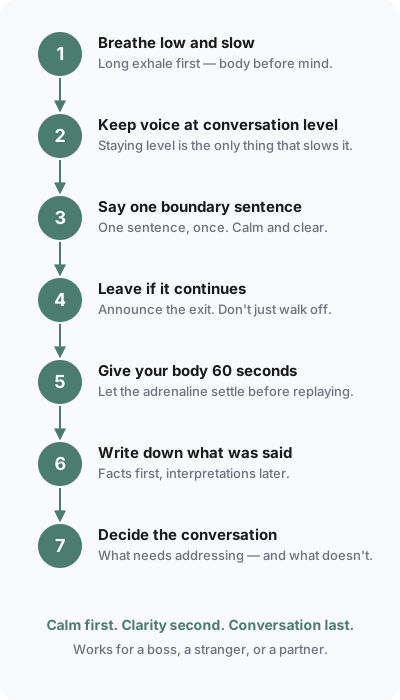
In the moment: steps 1–4
1. Breathe low and slow
Being yelled at floods your body with adrenaline — that's the shaking and the blank mind. Slow your exhale: in for four counts, out for six. You're not calming down for them; you're keeping your own thinking online.
That's not a metaphor. "Long, slow exhalations help bring the parasympathetic nervous system online," as Harvard Health's explainer on the stress response puts it. Melissa Young, MD, an integrative medicine specialist at Cleveland Clinic, is blunter about why the shortcut works: "When we're anxious, we breathe shallowly and quickly, which actually creates more anxiety within your body. We can use breathwork to move out of the fight-or-flight state and into that parasympathetic nervous system."
2. Don't match the volume
Yelling back feels like self-defense, but it hands the moment to escalation. A conversation-level voice is not surrender — it's the only response that doesn't feed the fire.
3. Say one boundary sentence
One calm sentence, said once: "I can't hear you when you're yelling. Let's continue when we can both talk." Don't repeat it, don't debate it — repetition reads as provocation.
4. Leave if it continues
You're allowed to exit. An exit script keeps the door open without accepting the volume: "I'm stepping away, not walking out. We can pick this up later." If leaving doesn't feel safe, that's important information — see the last section of this page.
Right after: steps 5–6
5. Give your body 60 seconds to reset
The stress chemicals don't clear the instant the yelling stops. Before you replay anything or type anything, let your nervous system come down first.
Treat 60 seconds as the floor, not the finish line. When a couple is this activated, therapists who work in the Gottman method advise a longer break — "at least twenty minutes since it will take that much time for your bodies to physiologically calm down," in Dr. Ellie Wilde's description of stonewalling. You don't owe anyone a debate while your pulse is still up; you owe yourself enough time to speak with it down.
Why you cry when someone yells at you
Tears under a raised voice are a pressure-release valve, not a verdict. The overflow can come from anger and overwhelm as easily as from sadness, which is why it shows up so often in people who are sure they aren't sad about it. Fight, flight, or freeze is running the moment, and crying is one of the ways a body sheds charge it has no other way to discharge.
That's also why the reflex fix — clamp down hard enough to look composed — tends to make you less steady rather than more. Swallowing tears with a locked jaw and shallow breath keeps the arousal in your body and splits your attention between holding yourself together and actually answering. You end up doing both badly.
What helps is small and physical: lengthen the exhale, let your jaw unclench, put both feet flat on the floor. If the tears come anyway, let them come, and say what you meant anyway — "I'm upset, and I still mean what I said. I need a minute before we continue." Crying doesn't mean you're weak, and it doesn't mean the other person is right.
Shaky right now? Try Calm Now — a free 60-second breathing space. Nothing is saved, nothing is tracked. Take a breath →6. Write down what was said
While it's fresh, note the facts: what was said, by whom, about what. Facts, not interpretations — memory bends fast under emotion, and a plain record protects you from second-guessing yourself later.
Later: step 7
7. Decide the conversation
Not every yelling incident needs a summit — but repeated ones do. Decide three things: what to address (the yelling itself, not the topic they yelled about), when (once both of you are genuinely calm), and whether (a stranger in traffic doesn't get a follow-up; the people in your life do). When you're ready for the actual words: What to say after a fight — copy-ready scripts →
If this keeps happening
A one-off blowup and a repeating pattern are different problems. If being yelled at is becoming a regular part of any relationship in your life, the question shifts from "how do I handle this moment" to "is this pattern okay" — and that deserves a careful answer, not a shrug: Is yelling normal in a relationship? →
If it's your partner, we've written role-specific guides that go deeper on the why and the repair: My husband is yelling at me → · My wife is yelling at me →
If it's a boss or coworker: the steps above still apply, but the follow-up differs — keep dated written records of incidents, know your company's HR process, and remember that a workplace where yelling is routine is a workplace problem, not a you problem.
If it's a parent or family member: the steps above still apply, but the pattern may be older and deeper than any single argument. Naming it — even just to yourself — is often the first real shift. You're not obligated to keep showing up for yelling just because it's family.
If it's a stranger — a driver, a customer, someone online: steps 1 through 4 are all you need. You don't owe them a follow-up conversation, and their yelling is about them, not you. Let it go.
And in any relationship: if yelling comes with threats, thrown objects, or fear for your safety, that's beyond technique. Find support resources by country →
Key takeaways
- When someone yells at you, start with a low, slow breath to steady your body — freezing, crying, or shaking are automatic stress responses, not weakness or guilt.
- Keep your voice at conversation level and say one boundary sentence like "I want to hear you, but not at this volume" — if the yelling continues, leaving the room is the right move, not a loss.
- Right after the yelling stops, give your body 60 seconds to reset, then write down what was said with facts only — this helps you think clearly and creates a record if you ever need one.
- Some yelling is a bad moment, but frequent yelling aimed at you may cross into verbal abuse — if any part of it left you afraid, trust that feeling as information and look at the support resources where you live.
Frequently asked questions
Why do I freeze when someone yells at me?
Freezing is one of the body's built-in stress responses — fight, flight, or freeze. When your brain reads a voice as a threat, it can lock you up before you get a vote. It's not weakness or guilt; it's biology. The grounding breath in step 1 is how you hand control back to the thinking part of your brain.
Why do I cry when someone yells at me?
Tears under stress are a pressure-release valve for your nervous system — they can come from anger and overwhelm just as easily as sadness. Crying doesn't mean you lost the argument or that they're right. If it happens, it's okay to name it plainly: "I'm upset, and I still mean what I said."
How do I stop myself from crying when someone yells at me?
You can reduce it, but you can't fully override a stress response on command — and fighting the tears usually brings them faster. What helps: slow your exhale longer than your inhale, press your tongue to the roof of your mouth, and shift your gaze slightly upward for a few seconds. Silently name what's happening ("this is stress, not weakness") — naming it gives your thinking brain a foothold. And if the tears come anyway, that's not a failure: you can say "I'm upset, and I still mean what I said," and hold your ground.
Should I yell back?
It's a human impulse — and it almost always makes things worse. Two raised voices escalate faster than one, and afterward the original issue is buried under the shouting match. Holding conversation volume (or leaving) isn't losing; it's refusing to play a game nobody wins.
When is yelling abuse?
Yelling moves toward verbal abuse when it's frequent, aimed at you rather than the situation, loaded with insults or threats, or leaves you afraid or constantly on guard. Occasional raised voices happen in many relationships and aren't automatically abuse. If you're asking this question about someone in your life, take the gentle self-check: Is yelling normal in a relationship? →
If any part of this page made you think about your own safety: support resources by country →
Sources
- Harvard Health — Fight, Flight, or Freeze — why your body freezes, shakes, or cries when someone yells
- The National Domestic Violence Hotline — What Is Emotional Abuse — definitions and warning signs of emotional and verbal abuse
- Cleveland Clinic — How Box Breathing Can Help You Destress — what slow breathing actually does to the stress response
- The Gottman Institute — The Four Horsemen: Stonewalling — why a flooded nervous system needs a longer break than a pause